

Santa Cruz Ulta Trek: The "Ultimate" Panoramas of the Andes
Duration:
6 days trekking (with 7 day option)
Grade:
Moderate to Hard
Highest Point:
4850m
The classic Santa Cruz trek is famous for a reason, but the Santa Cruz Ulta Trek takes the experience to a whole new level. By changing the final two days of the standard itinerary, this route transforms a great trek into a world-class expedition.
Instead of descending into the dusty canyon of Cashapampa, we divert towards the dramatic Punta Yanayacu Pass (4,850m). This “secret exit” grants you the single most impressive close-up view of Nevado Huascarán (6768m) and Chopicalqui available on any trekking route. It is slightly more challenging, far less crowded, and infinitely more rewarding.
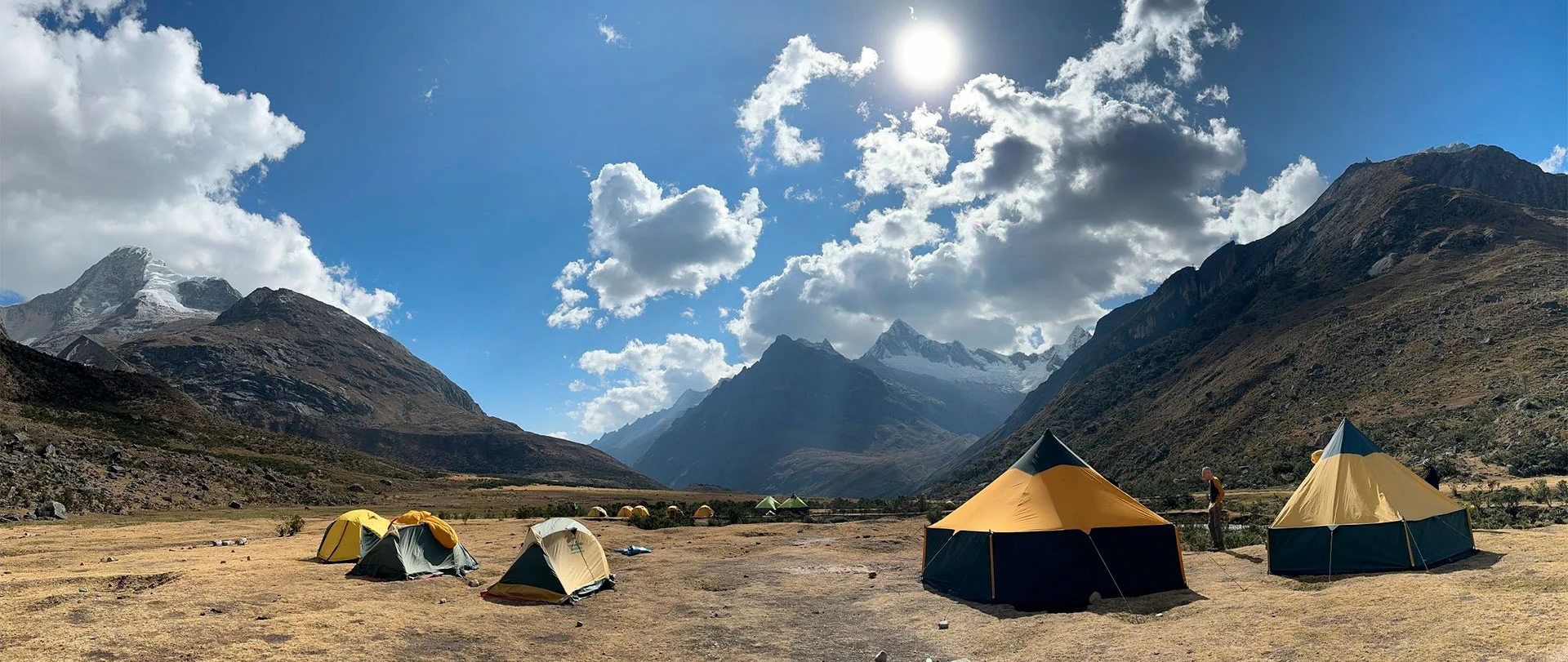
This is an awesome, medium-length trek in the Cordillera Blanca range, whose popularity is due to several spectacular mountain panoramas, views of crystal-blue lakes and the challenge posed by two high passes: Punta Union (4750m) and Punta Yanayacu (4850m), not to mention our last, breathtaking high camp on the Avalancha plateau. This trek offers an amazing variety of scenery and hiking.
Why Choose the Ulta Route vs. The Classic?
While the classic route ends with a long descent, the Ulta route keeps you high in the alpine zone for longer.
The Yanayacu Pass: The highlight of this trek. Standing on this pass, you are surrounded by a 360-degree amphitheater of glaciers, including Contrahierbas and the Ulta glacier.
Escape the Crowds: The classic Santa Cruz can get busy. Once we divert towards Ulta, we often have the mountains entirely to ourselves.
Photography: If your goal is to photograph the big giants like Huascarán South, this is the route for you. The angle from the Ulta Valley is simply unmatched.
A Challenge for True Adventurers
The Santa Cruz Ulta Trek is graded as Moderate to Hard. It involves an extra high pass compared to the classic version.
You need to be well-acclimatized, as we will cross two passes over 4,700m: the famous Punta Union (4,750m) and the spectacular Punta Yanayacu (4,850m). The reward for this extra effort is a descent through the pristine Ulta Valley, a place of jagged granite walls and hanging glaciers that feels like the Patagonia of Peru.


Note 1: Grading
We grade the trek as moderate to hard because, although the hiking is not technically difficult, the high altitude makes the hiking harder than on a similar trek at lower altitude. You do need to have a good level of fitness and be able to hike sustained uphills of up to 3 hours to the passes, and also be able to manage long descents from those passes.
Most trekking options in the Cordillera Blanca should be considered to be physically demanding owing to the altitude (you are above 4000m for the duration of the treks) and the mountainous nature of the terrain. Trails on this trek are in some places steep – both ascending and descending and can be slippery & uneven in places. If you do not think you can enjoy this type of trekking, let us know and we can suggest some easier options
There is a long descent down from the final pass on the final day of trekking. The descent is steep on shingle scree for about 30m which can be slippery for those not accustomed to this type of trail. The rest of the descent is long (can take two to 2.5 hours to get down) and is at times on an uneven trail with some stepping down required. Good knees and / or trekking poles are suggested
Note 2
Although the Santa Cruz trek route is located within the Huascaran National Park, local communities retain the traditional rights to graze farm animals that they have had for generations before the National Park was created. There are some farm animals (cattle, sheep, horses) along the trekking route, included surprisingly at the top of the high passes
Itinerary
Day A: Arrive Huaraz
Day B & C: Huaraz / Acclimatisation days with day hike (two days – 3 nights minimum is highly recommended for acclimatisation)
Drive to Cashapampa. Hike up the Santa Cruz Valley to Llamacorral
From Huaraz we drive along the broad Callejón de Huaylas valley to Caraz, then up to the village of Cashapampa (2900m). 3 hours. Approaching Cashapampa we have our first view of Nevado Santa Cruz, an imposing pyramidal snow peak that gives the trekking circuit its name. We begin our trek with a steady ascent through the lower Santa Cruz valley, following a tumbling river as we go. The first 2 hours are through a steep-sided gorge, with the going occasionally tough as the continuous ascent and usually hot conditions take their toll. By early afternoon, however, the gradient begins to level out and the valley to open out onto cooler puna grasslands as we approach our first camp, close to the river at Llamacorral (3750m).
- Approx. 9kms
- 5 hours
- Highest point 3750m
- Altitude at camp 3750m
- Ascent for the day 850m
Llamacorral to Taullipampa, with optional Arhuaycocha side trip
Today we enjoy an easier day’s walk up the open valley to our camp at Taullipampa (4250m). The direct route takes about 4 hours. The going is mostly flat with only a gentle incline and just the final hour to Taullipampa camp mostly uphill.
We cross an area of barren washout where in the year 2014 an avalanche coming off Artesonraju caused a flash flood that washed out the upper part of the Santa Cruz Valley, destroying the trail and also completely burying the shallow lake named Ichicocha. Now only the larger lake Jatuncocha remains and we make a pleasant traverse around the side of this lake before crossing another sandy washout area to the other side of the valley.
During the day’s hike, the neighbouring peaks of Quitaraju (6,040m) and the famous Alpamayo South Face (5,947m) come briefly into view.
An optional, and recommended, side trip from Quisuar up a zigzagging trail takes you to the hanging Arhuaycocha valley and beyond to Alpamayo Base Camp and Laguna Arhuaycocha. This optional detour allows closer views of Alpamayo (once voted the world’s most beautiful mountain), Artesonraju (6,025m) and Quitaraju, before traversing via a little-used track to our Taullipamapa camp.
Our camp is situated almost at the base of the beautiful Taulliraju snow peak, and is surrounded by others, including Paria, Artesonraju and Rinrijirca (5,810m).
- Approx 10 kms direct Llamacorral to Taullipampa
- 4 hours hiking or add 1 to 3 hours extra if hike towards Alpamayo Base Camp
- Highest point 4250m
- Altitude at camp 4250m
- Ascent for the day 500m
Optional Extra Day
We can add an extra day here and stay on at the beautiful Taullipampa Camp. Options would include either a hike up Centillo Peak (5000m – approx 4 hours); a mixed climb on an uneven path and rock, but not technical (rope not needed), a beautiful hike up to the Laguna Arhuaycocha glacial lake (4350m – approx 4 hours there & back), with its awesome backdrop of the Rinrijirca peak (5,810m), or a hike to a high glacial lake at the base of Artesonraju (approx 4 hours). Alternatively, you could enjoy a rest day surrounded by awesome scenery.
Taullipampa to Paria via Punta Union pass
From Taullipampa camp, we ascend steadily on a good path for some 2½ to 3 hours, gradually nearing the continental divide at Punta Union pass (4750m). Most will feel some shortness of breath on the approach, as the altitude takes its effect; consequently we aim to take our time. From the pass we enjoy stunning views of several snow peaks, including Rinrijirca, Pucajirca (6050m), Artesonraju and the nearby Nevado Taulliraju (5830m), a towering, jagged presence. Looking back down the Santa Cruz Valley, we see Lake Jutuncocha in the distance. From the pass it is a long descent into the beautiful Quebrada Huaripampa valley past two small lakes and several patches of red-barked quenual (polylepis sp.) forest. Tonight’s camp will be on a plateau, away from the main trail, in the secluded Quebrada Paria valley (3900m).
- Approx. 13kms
- 7 hours
- Highest point 4750m
- Altitude at camp 3900m
- Ascent for the day 500m
Hike Paria to Molino Pampa
An easy, relaxing walk through the lower Quebrada Huaripampa valley takes us through the scattered farming settlements of Huaripampa and Colcabamba. Here we pass several farm houses and encounter a lot of local people, including children. (This is a good day if you have chosen to bring small gifts for children, such as pens, pencils and notebooks. The kids are quite poor and truly appreciate such things which they use for their schoolwork). From Colcabamba there is now a road which we have to follow for around one to 1½ hours, climbing steadily to the village of Challhua. We can then take a path away from the road before traversing easily to our campsite at Molino Pampa (3600m) in the narrow Quebrada Keshu Valley.
- Approx. 13kms
- 6 to 7 hours
- Highest point 3900m
- Altitude at camp 3600m
- Ascent for the day 300m
Molino Pampa to Avalancha camp
Today is not long, but it offers dramatic scenery and swift height gain. We begin with a steady ascent of the Keshu Valley on a good path. We pass through some amazing ancient quenual (polylepis sp.) forest until we reach moraine enclosing two glacial lakes fed by the ice coming off the glaciers of the nearby Contrhierbas massif. At this point the climb steepens as we head up the valley’s north side on a zig zag path to a small plateau where our high campsite, Avalancha (4650m), is located. Directly across the valley from our spectacular camp is the long glacier-encrusted massif of Contrahierbas (6037m). Frequent avalanches from its fissured glaciers come crashing down into the lake below. We can spend the afternoon resting and avalanche watching!
- Approx. 7kms
- 4 hours
- Highest point 4650m
- Altitude at camp 4650m
- Ascent for the day 1050m
Avalancha Camp to Ulta Valley via Yanayacu pass. Drive to Huaraz
We traverse and ascend for 1½ to two hours to a high narrow ledge and on to a knife-edge pass. This is our last and most spectacular pass, Punta Yanayacu (4850m). Hereabouts, Andean Condors nest and are sometimes spotted in flight. From here we have close views of the Chopicalqui and Contrahierbas snow peaks. Then there’s a zig zag descent on an initially steep path into the Cancahua valley below. It can sometimes be a little slippery and icy here for just a few short meters, but it is the guide will help you. We walk past some small lakes and again are surrounded by snow-capped peaks, including Contahierbas, the pyramidal Nevado Ulta to the south, and the highest, Huascarán (6768m), to the northwest. We finish the trek with a long descent through quenual forest to the beautiful Quebrada Ulta valley, descending to 3900m, where our vehicle will be waiting to take us back to Huaraz.
- Approx. 10kms
- 5 to 6 hours
- Highest point 4850m
- Ascent for the day 200m followed by approx. 950m of descent
- 2.5 hours drive on a newly paved road, 60kms to Huaraz
Hiking Hours & Kms Hiked
Hiking hours are estimated times including rest breaks and lunch stop. Times are for our average groups based on past experience. Some people may be much faster and others slower.
Kms hiked are estimated.
Trek Roads
Access roads to and from treks are generally dirt mountain roads (not paved) and in some places can be bumpy. Road travel times are slower than you may expect for the kms travelled.
Frequently Asked Questions
Is the Santa Cruz Ulta trek difficult?
Yes, it is physically more demanding than the classic 4-day route because it adds a second high pass (Yanayacu) and typically lasts 6 days. Good fitness and previous acclimatization (like the Laguna 69 hike) are strongly recommended.
What is the main difference between Ulta and the Classic trek?
The Classic route descends via a canyon to Cashapampa (mostly downhill). The Ulta route climbs up again to cross a second mountain range, offering superior views of the highest peaks like Huascarán before descending into the Ulta Valley.
When is the best time to do this trek?
The best season is the Andean dry season, from May to September, when you have the best chance of clear skies for the panoramic views at Yanayacu Pass.
Print Copy / PDF trek description & more photos
For more information & prices